Days on the mountain, more than anything else. Across the industry, 5-day climbs summit roughly 60–70% of the time; 7-day climbs exceed 85%; 8-day Lemosho climbs are higher still. Extra days are not luxury — they are acclimatization, and acclimatization is the summit.
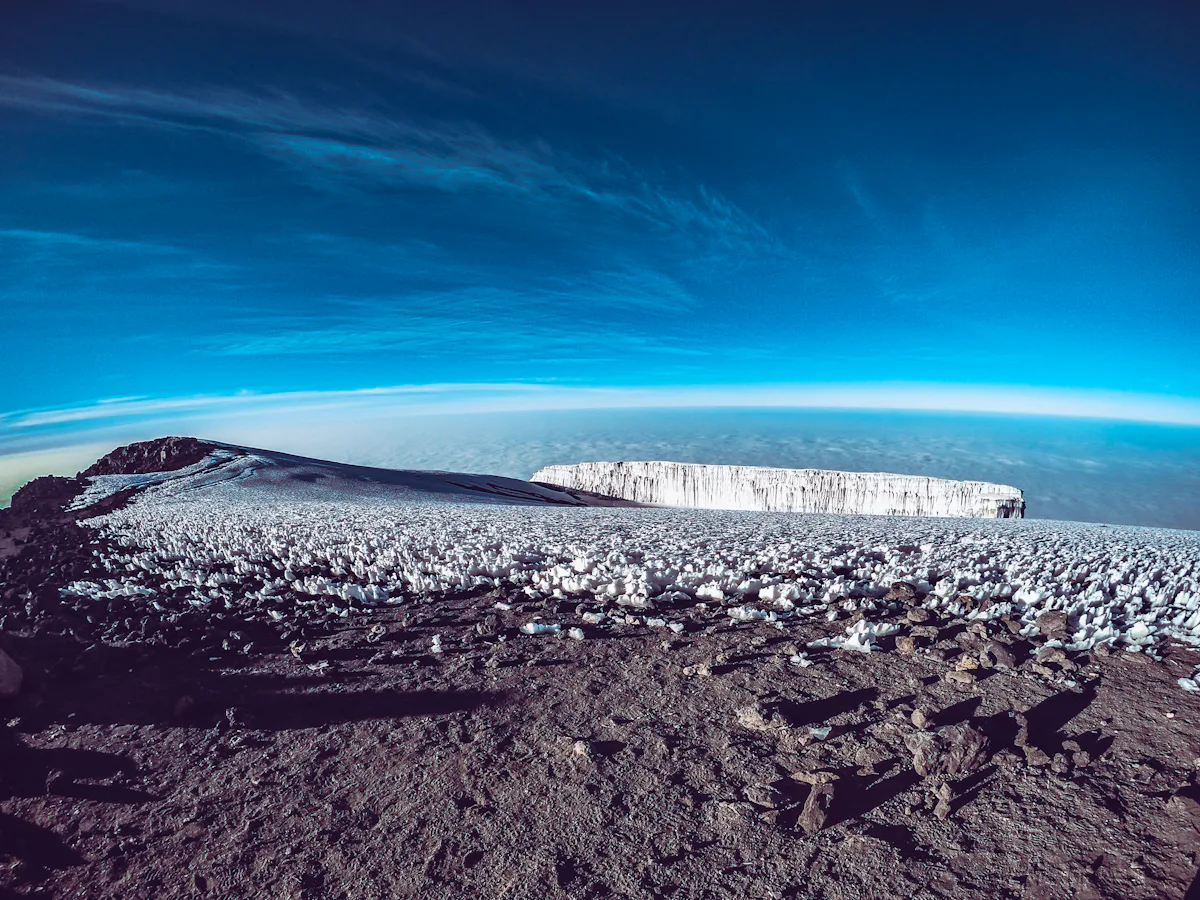
Kilimanjaro
No ropes, no ice axes — just 5,895 metres of altitude and one decision that matters more than your fitness: the route.
| Best for | A life milestone you train for — often paired with a safari or Zanzibar recovery |
|---|---|
| Time needed | 6–8 days on the mountain; we recommend 7 minimum |
| Difficulty | Non-technical trek; summit night is genuinely hard — cold, dark, slow |
| Best months | Jan–Mar (colder, quieter) and Jun–Oct (busier, drier) |
| Pairs with | 3–4 day northern-circuit safari or a Zanzibar recovery week |
What determines whether you summit?
The second factor is crew quality. Your guides carry pulse oximeters and make the call that keeps you safe; your cooks keep your appetite alive at 4,000 m where altitude kills it. We run KPAP-standard porter welfare — fair loads, fair pay, proper gear — because a mistreated crew cannot take care of you, and because it is right.
Machame or Lemosho?
The two routes we run most, honestly compared:
| Machame — 7 days | Lemosho — 8 days | |
|---|---|---|
| Character | The classic “whiskey route” — scenic, sociable, direct | Quieter western start, one more acclimatization day |
| Summit success | ~85% on 7 days | ~90%+ on 8 days |
| Crowds | Busiest camps on the mountain | Quiet for 2 days, joins Machame at Shira |
| From-price | $2,650 pp | $3,100 pp |
| Choose it if | Budget-aware, fit, short on days | You want the best odds and the quietest start |
Full comparison with day-by-day profiles: Machame vs Lemosho in the journal.
Honest trade-offs
- Summit night is brutal for everyone. Six to eight hours in the dark at −10 to −20°C, on half the oxygen you are used to. Everyone who tells you otherwise is selling something.
- Cheap climbs cut crew welfare first. A $1,700 climb pays for itself out of porter wages and food quality. That is the whole difference.
- Fitness helps; humility summits. Marathon runners fail by going too fast. “Pole pole” — slowly, slowly — is the mountain’s only rule.
Kilimanjaro questions we answer every week
When is the best time to climb Kilimanjaro?
January–early March: colder and quieter, with the best summit-day visibility. June–October: drier and warmer, but the camps are fuller. Avoid April–May and November, when rain makes the lower forest miserable and the summit views uncertain.
Do I need previous trekking experience?
No. You need honest hill-walking fitness (comfortable with 5–7 hour walking days, several days in a row), decent gear — we send a full list and rent what you lack — and the patience to walk slower than feels natural.
How much does a safe Kilimanjaro climb cost?
From roughly $2,400–3,500 per person for a properly crewed 7–8 day climb, of which about $1,000 is park and rescue fees alone. Quotes far below that are cutting porter pay, food, or days — the three things that get people down safely.
Stand on the roof of Africa
Signature itineraries
Choose your route to the summit
Three ways up the mountain, each with full day-by-day detail, honest per-day pricing, and pre/post-climb hotels with photos.